The Pharisee and the Tax Collector
Two men prayed. One listed his accomplishments. The other beat his chest and begged for mercy. Only one went home justified. Discover the prayer God always answers.
Choose Your Experience
The Pharisee and the Tax Collector
The Hook
Two men walked into the temple to pray. One was the best person in the room — by every measurable standard. The other was the worst. One left right with God. The other didn't. And it's not who you'd expect.
The Story
Jesus told this parable to "some who were confident of their own righteousness and looked down on everyone else."
Two men went up to the temple to pray. One was a Pharisee. The other was a tax collector.
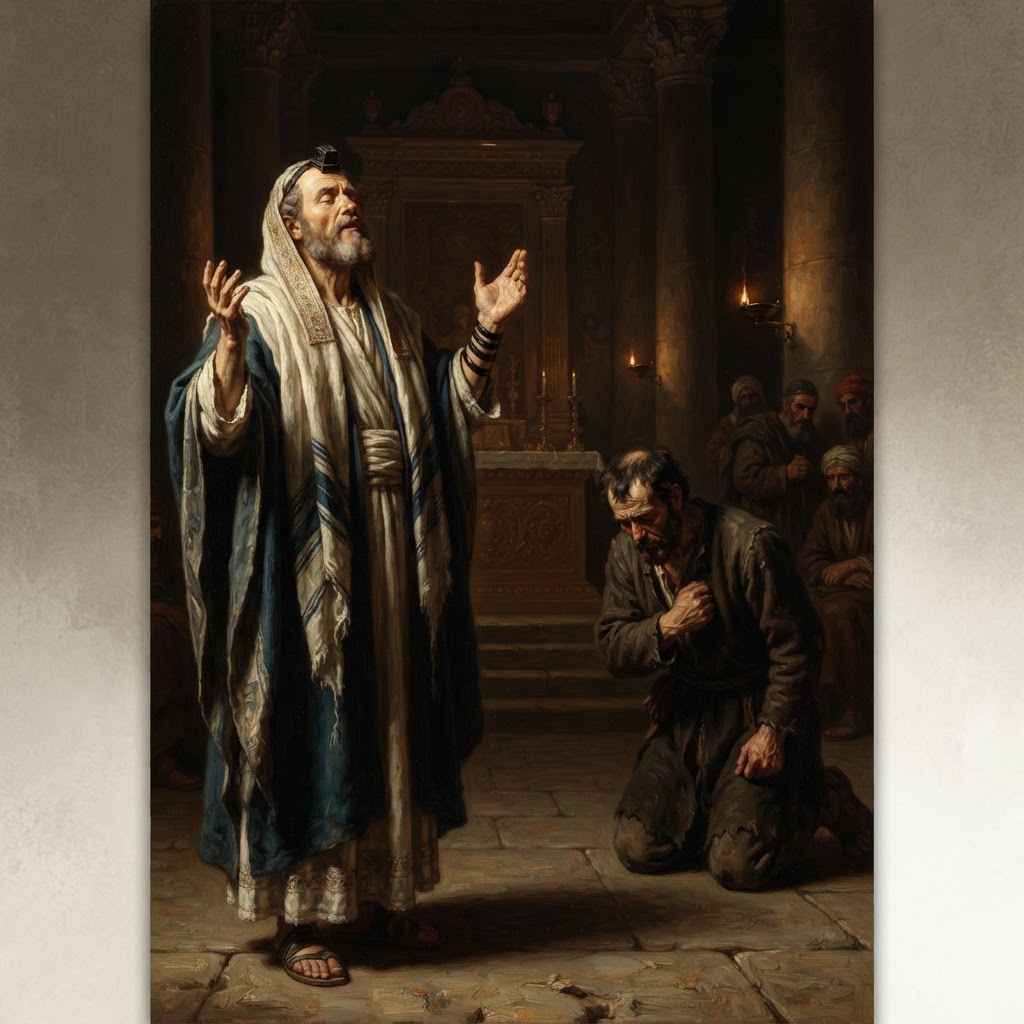
The Pharisee stood by himself and prayed: "God, I thank you that I am not like other people — robbers, evildoers, adulterers — or even like this tax collector. I fast twice a week and give a tenth of all I get."
Notice: his prayer wasn't actually to God. It was about himself, directed at God. He thanked God — but not for God's grace. He thanked God that he was better than everyone else. His prayer was a spiritual résumé, not a conversation.
The tax collector stood at a distance. He wouldn't even look up toward heaven. He beat his breast and said: "God, have mercy on me, a sinner."
Seven words. No accomplishments. No comparisons. No self-justification. Just raw, honest need.
Jesus' verdict: "I tell you that this man, rather than the other, went home justified before God. For all those who exalt themselves will be humbled, and those who humble themselves will be exalted."
The Lesson
1. God doesn't grade on a curve. The Pharisee was comparing himself to the tax collector — and winning. But God isn't comparing you to the person next to you. He's measuring your heart against His holiness. And in that comparison, we all fall short.
2. Pride disguises itself as gratitude. The Pharisee started with "I thank you" — but his gratitude was self-congratulation. True gratitude says, "God, everything good in me is because of You." Pride says, "God, thank You that I'm better than them."
3. Distance reveals reverence. The tax collector "stood at a distance" and "would not even look up to heaven." He knew he had no right to approach God on his own merit. That's not self-hatred — it's honesty. And God honored it.
4. God justifies the humble, not the impressive. The word "justified" means declared righteous. Not earned. Given. The tax collector didn't earn it. He simply acknowledged his need. And that was enough.
Key Takeaways
- Your spiritual résumé is worthless before God. Fasting, tithing, serving — all good things. But they don't earn justification.
- Comparison kills humility. The moment you start looking at others, you've stopped looking at God.
- Honesty is the doorway to grace. The tax collector didn't clean himself up first. He came as he was — and God accepted him.
- Humility is exalting. "Those who humble themselves will be exalted." The way up in God's kingdom is down.
Real-Life Application
- When praying: Skip the résumé. Start with honesty. "God, I need You" is a better opening than "God, I thank You I'm not like..."
- When tempted to compare: Stop. Look at God's holiness, not your neighbor's sin. That'll humble you fast.
- When feeling spiritually proud: Remember that everything good in you is a gift. You didn't earn it. You can't boast in it.
Closing Prayer
God, have mercy on me, a sinner. I have nothing to offer You but my need. Forgive me for the times I've prayed like the Pharisee — comparing, listing, justifying. Give me the honesty of the tax collector and the humility that opens the door to Your grace. Amen.
Memory Verse
"For all those who exalt themselves will be humbled, and those who humble themselves will be exalted." — Luke 18:14
Series Complete!
You've journeyed through seven of Jesus' most powerful parables. Each one is a mirror — showing us who we are, who God is, and what life looks like when we live according to His kingdom rather than ours.
Ready for more? Check out Series 4: From Broken to Blessed — stories of people who hit rock bottom and found God waiting there.
Key Takeaway
God doesn't grade on a curve. He's not comparing you to others — He's asking for your honest, humble heart. The one who knows they need mercy is the one who receives it.
Family Discussion
1. When you pray, do you sound more like the Pharisee (listing your good deeds) or the tax collector (pleading for mercy)?
2. What does it look like to humble yourself before God in practical, daily terms?
3. Why is it so easy to compare ourselves to others rather than seeing ourselves honestly before God?
4. What area of pride is God asking you to surrender right now?
Quick Quiz
Sign in to test your knowledge and track your progress.
Sign In to Take Quiz